Telescop / Features / AI Visibility Software: Brand and Competitor Monitoring
AI Visibility Intelligence

AI Visibility Software: Monitor Brands, Competitors and AI Citations

See how your brand appears in observed ChatGPT, Gemini and Google AI answers. Compare competitors by topic and prompt, distinguish mentions from measurable recommendations and source citations, and find gaps worth investigating.

AI platforms monitored
ChatGPT Gemini Google AI Overview Google AI Mode
Independent monitoring, subject to AI surface availability. Trademarks belong to their owners; no affiliation or endorsement is implied.
Measured signals
Weighted Share of Voice Recommendation Share Citation Share Competitive gaps
The question it answersWhen a potential buyer asks AI assistants which tools or providers to choose, is your brand mentioned, cited as a source or recommended? Which competitors appear instead?
Four distinct metrics

How to read AI Visibility metrics

Four metrics answer four different questions: does the brand appear, how prominent is it, is it recommended, and is its website cited as a source?

AI Visibility

Do AI answers mention me?

The share of valid observed AI answers mentioning the brand. It measures presence, not preference or website traffic.

Weighted Share of Voice (SoV)

How much competitive prominence do I have?

The weighted share of mentions among monitored brands, based on query weight, position and mention type. It is not market share.

Recommendation Share

Am I recommended?

The weighted share of competitive recommendations attributed to the brand. A mention alone does not count. When recommendations cannot be measured, the result should not be read as zero.

Citation Share

Is my website cited as a source?

The weighted share of citations pointing to the brand domain compared with monitored competitors. A visible citation does not prove the content was used to generate the answer.

Percentages describe only the observed sample and period, not all AI users. A citation is not a recommendation; an unmeasured metric must not be confused with a measured zero.

What it observes

Signals that shape the market reading

Tracking starts from prompts aligned with market needs. Telescop separates valid observations from unavailable AI surfaces, so a provider failure is not silently counted as zero visibility.

  • Brand and competitor presence by prompt, topic and observed AI surface.
  • Weighted Share of Voice, accounting for query relevance, mention position and mention type.
  • Recommendation Share where the answer semantics can be classified reliably.
  • Citation Share and source domains, separating cited pages from recurring sources in AI answers.
  • Competitive gaps between brand exposure, recommendations and source citations.
What it returns

Outputs designed for decisions, not dashboard clutter

Visibility by topicDiscover the needs and comparisons where your brand appears, and on which AI surfaces.
Competitive comparisonIdentify where other brands gain mentions or recommendations in the observed panel.
Sources and citation mapSeparate cited pages from search sources and assess editorial opportunities.
How to read it

From signal to next step

Select topics and promptsStart with the questions buyers ask while evaluating tools or providers.
Collect observationsKeep the observation period, surface availability and collection method distinct.
Interpret the metricsSeparate brand mentions, weighted presence, recommendations and citations.
Prioritize the gapsInvestigate high-value topics and sources, then track changes with a stable prompt panel.
Example

Example: being visible is not the same as being recommended

Scenario

Illustrative scenario: two software providers are both mentioned, but only one is explicitly recommended in some answers.

What can emerge

  • Presence: both brands are mentioned.
  • Recommendation: one brand is explicitly suggested; the other is merely listed.
  • Action: investigate the prompts and sources behind the difference without assuming causation.
Dashboard preview · Telescop AI Visibility

A competitive map of how AI presents brands

This illustrative Telescop dashboard preview is reconstructed from an observation dated October 15, 2026, with competitor names blurred. Presence, weighted share of voice, recommendations and citations are distinct signals.
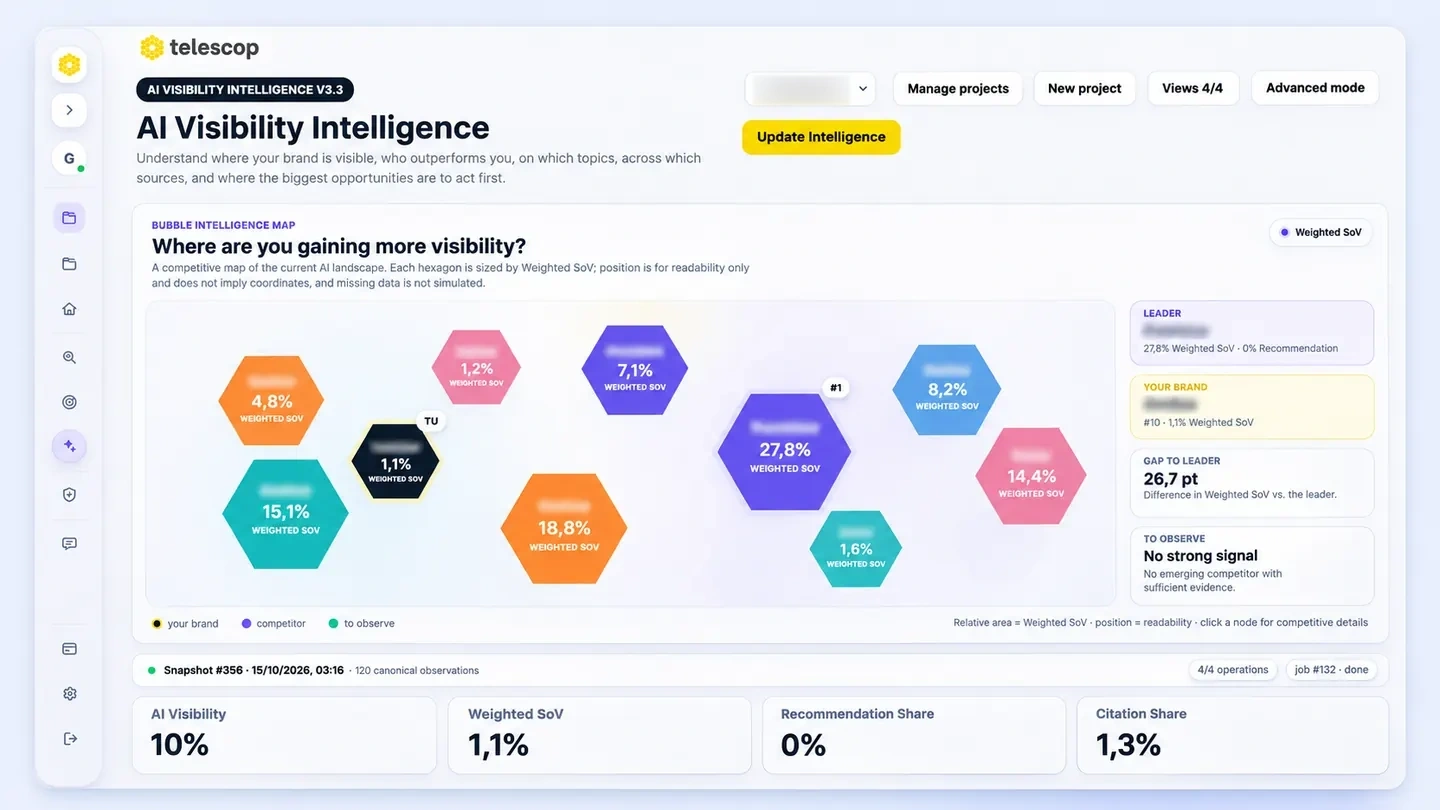
Illustrative Telescop AI Visibility dashboard preview with hexagonal competitive map and sample metrics: AI Visibility 10%, Weighted SoV 1.1%, Recommendation Share 0% and Citation Share 1.3%.
Illustrative graphic reconstruction based on a Telescop screen from October 15, 2026 (120 canonical observations). Figures refer to a single project sample, not market averages.
10% AI Visibility

The brand appears in a portion of observed answers. Presence alone does not prove preference.

1.1% Weighted SoV

Weighted share of voice captures the brand’s relative prominence within the monitored panel.

0% Recommendation Share

No explicit brand recommendation was measured in this sample; inspect buying prompts for the gap.

1.3% Citation Share

Some source citations are recorded, but citations and brand recommendations measure different outcomes.

Illustrative reconstruction, not a pixel-exact capture of the production interface. Figures describe a historical sample; provider coverage and results may change. Recommendations and citations are not guaranteed.

Practical monitoring

How to track brand visibility across ChatGPT, Gemini and Google AI

A single ChatGPT search cannot tell you how visible a brand is. You need a stable panel of questions reflecting customer needs, with language, market, dates and AI surfaces clearly documented. Telescop observes available answers and separates valid measurements from collection failures, so missing data is not mistaken for an absent brand.

Representative prompts and topicsGroup informational, comparison and buying questions by topic. Check whether your brand appears when people ask for a solution, not only when they explicitly type its name.
Results broken down by AI surfaceChatGPT, Gemini, Google AI Overview and AI Mode do not always return the same answers. Compare coverage and dates without pretending different surfaces are interchangeable.
More than mentionsIdentify whether the brand is merely referenced, compared or recommended, and which domains are cited as sources. These signals answer different business questions.

AI answers can change over time. Visibility percentages describe the monitored sample, not every conversation people have with AI.

From metrics to decisions

From AI visibility to opportunities: search demand, competitors and sources

A brand may appear frequently in AI answers while remaining weak at the moments when buyers compare options. That is why it helps to interpret visibility alongside topics, search intent and available demand signals. The aim is not to invent another isolated score, but to find competitive gaps that deserve investigation and an actionable next step.

Demand and intentCompare monitored topics with the queries and intent signals available in Demand Intelligence when the datasets and scope are compatible. Prioritize customer needs that matter to the business.
Competitors and recommendation gapsFind topics where other brands are mentioned or recommended more often. A mention is not a preference, and an observed difference alone does not explain its cause.
Sources and testable actionsReview visible citations and recurring sources to form hypotheses about content, comparison pages and digital PR. Check the results in later monitoring cycles.

Reading signals together does not mean every metric is available on every surface, nor does it imply predicted leads or sales.

Buyer's checklist

How to choose AI visibility software for brand monitoring

Before comparing pricing plans and dashboards, examine how the data is collected. Reliable AI visibility software should make the prompt panel, actually observed AI platforms and metric definitions clear. A feature list cannot replace an auditable methodology: ask what each number measures and which decision it can realistically support.

Verifiable AI surface coverageCheck which platforms are monitored, how often observations are collected and what happens when an AI response is unavailable. A technical error should not silently become zero visibility.
Distinct, understandable metricsKeep brand presence, Weighted Share of Voice, recommendations and source citations separate. Look for examples, methodological limitations and consistent tracking over time.
Actionable, traceable findingsFavor tools that show the topics, competitors and sources behind their percentages, clarify priorities and separate promising opportunities from outcomes that have actually been demonstrated.

The right choice depends on your market, the number of brands monitored and the quality of evidence—not simply the number of charts.

Original evidence

Why multiple AI surfaces matter: an example from Telescop Research

In Telescop's AI Energy Choice Italy 2026 study, the Exposure leader changes across AI surfaces: Edison Energia leads on Gemini in the observed panel, while Plenitude leads on Google AI Overview. This illustrates why one prompt or one platform cannot describe the whole competitive picture.

2,589Responses in the final research sample
75.580%Edison Energia Exposure on Gemini
47.197%Plenitude Exposure on Google AI Overview

These percentages refer to a defined research sample and different AI surfaces. They are not market shares, sales figures or guarantees for other brands.

When to use it

Use cases

  • Monitor brand presence across ChatGPT, Gemini, Google AI Overview and AI Mode when surfaces are available.
  • Compare visibility by topic, buying intent and configured competitors.
  • Distinguish brand mentions from actual recommendations where measurement is reliable.
  • Identify recurring cited domains and potential content or digital PR opportunities.
FAQ

AI Visibility software: common questions

What does AI Visibility software measure?It measures brand presence in observed AI answers and, where possible, distinguishes mentions, recommendations, source citations and competitor comparisons.
Which AI surfaces does Telescop monitor?Monitoring covers ChatGPT, Gemini, Google AI Overview and Google AI Mode. Actual availability depends on individual platforms and collection providers.
Does Citation Share prove AI used my website as a source?Not necessarily. Telescop measures visible citations pointing to the domain. A citation alone does not prove the content was used to generate the answer or that the brand was recommended.
Does a brand mention count as a recommendation?No. An answer may list a brand as an example, alternative or reference without recommending it as a preferred choice.
Is AI Visibility the same as traditional SEO ranking?No. Rankings in conventional search results and appearances in AI answers measure different signals and must be interpreted separately.
How should I choose prompts to track?Start from real comparison and buying questions, organize them by topic and intent, and keep a consistent panel to measure changes over time.

Find out how AI assistants present your brand against competitors.

Examine mentions, share of voice, cited sources and recommendations across the prompts that matter to your market.